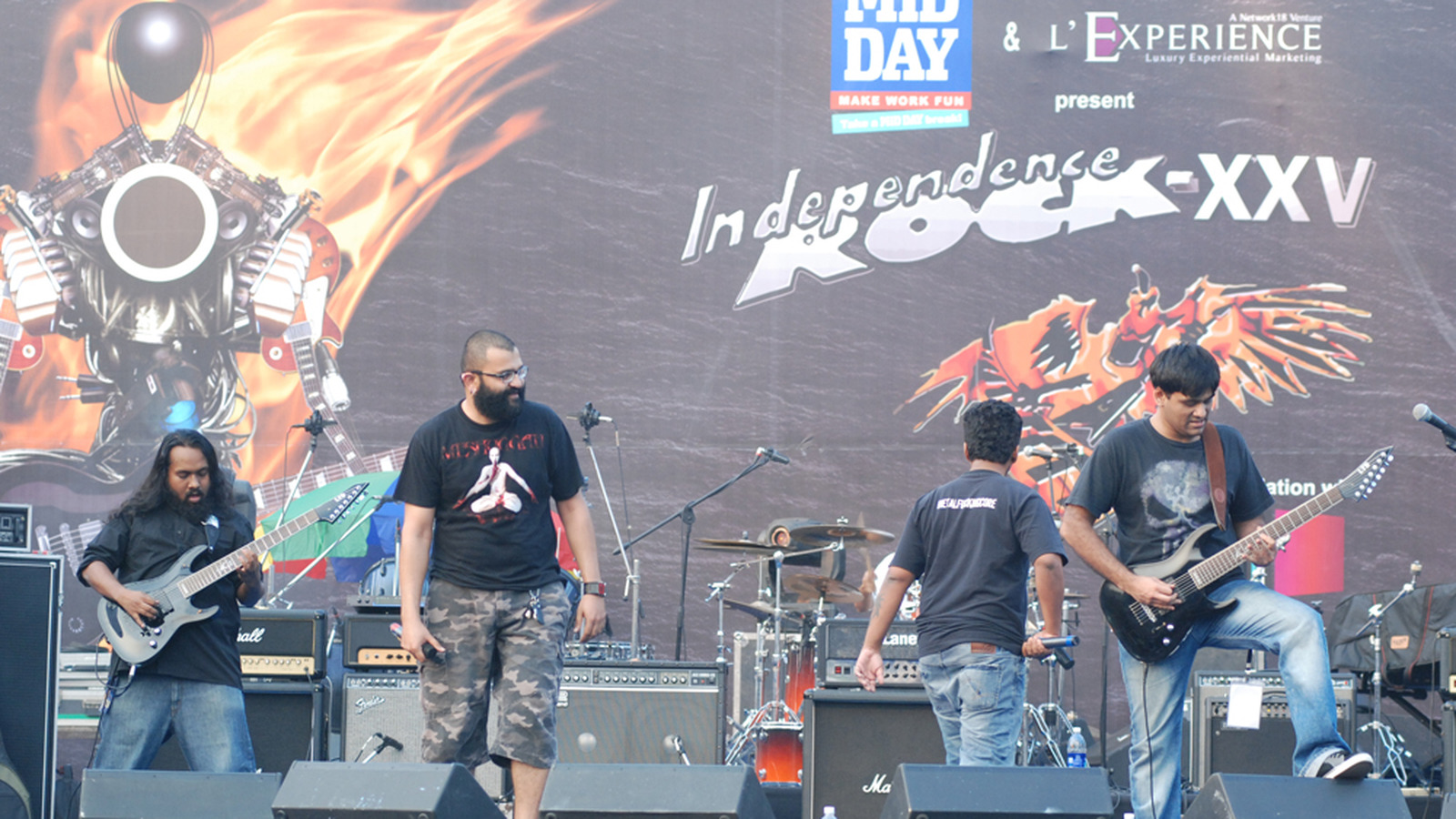
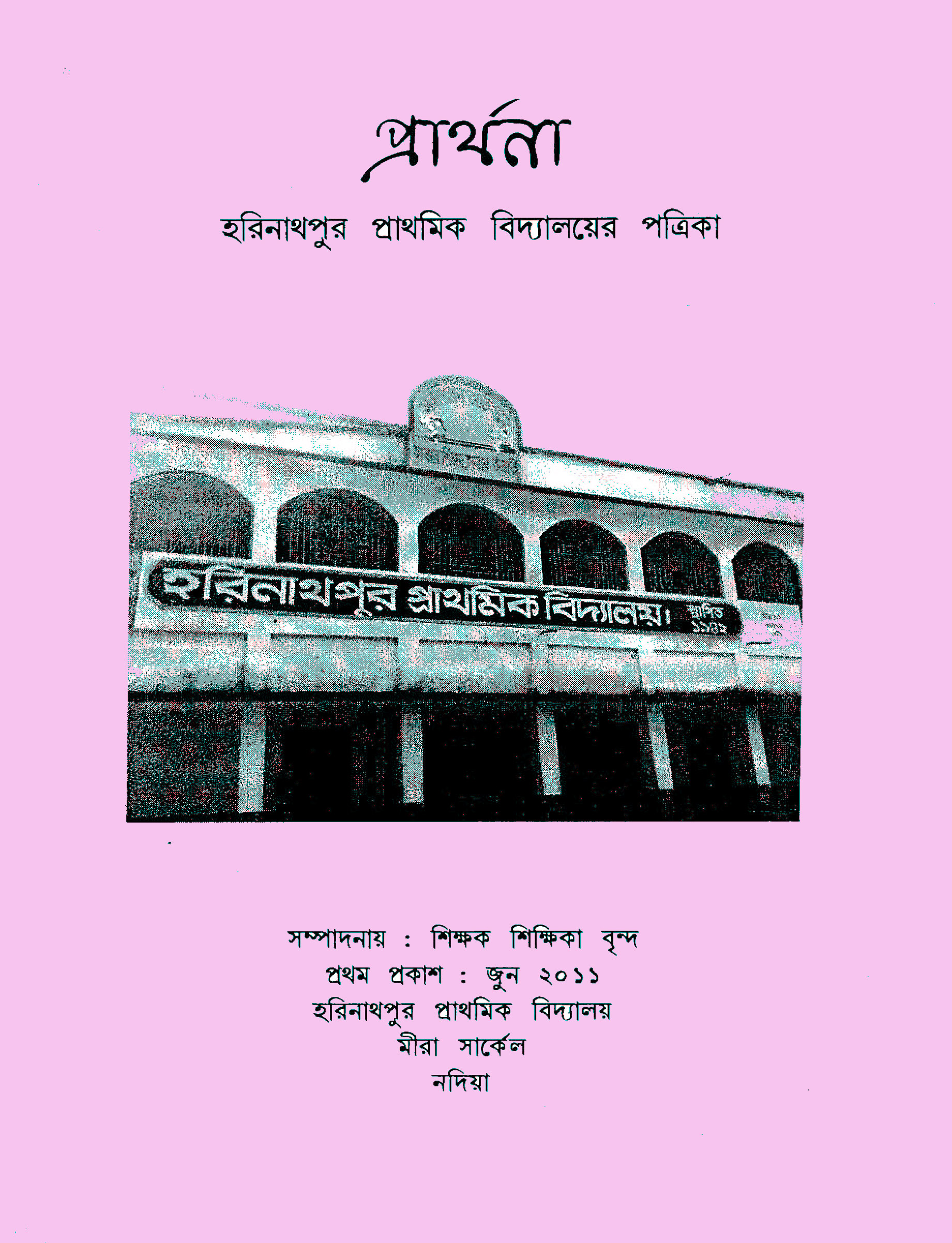
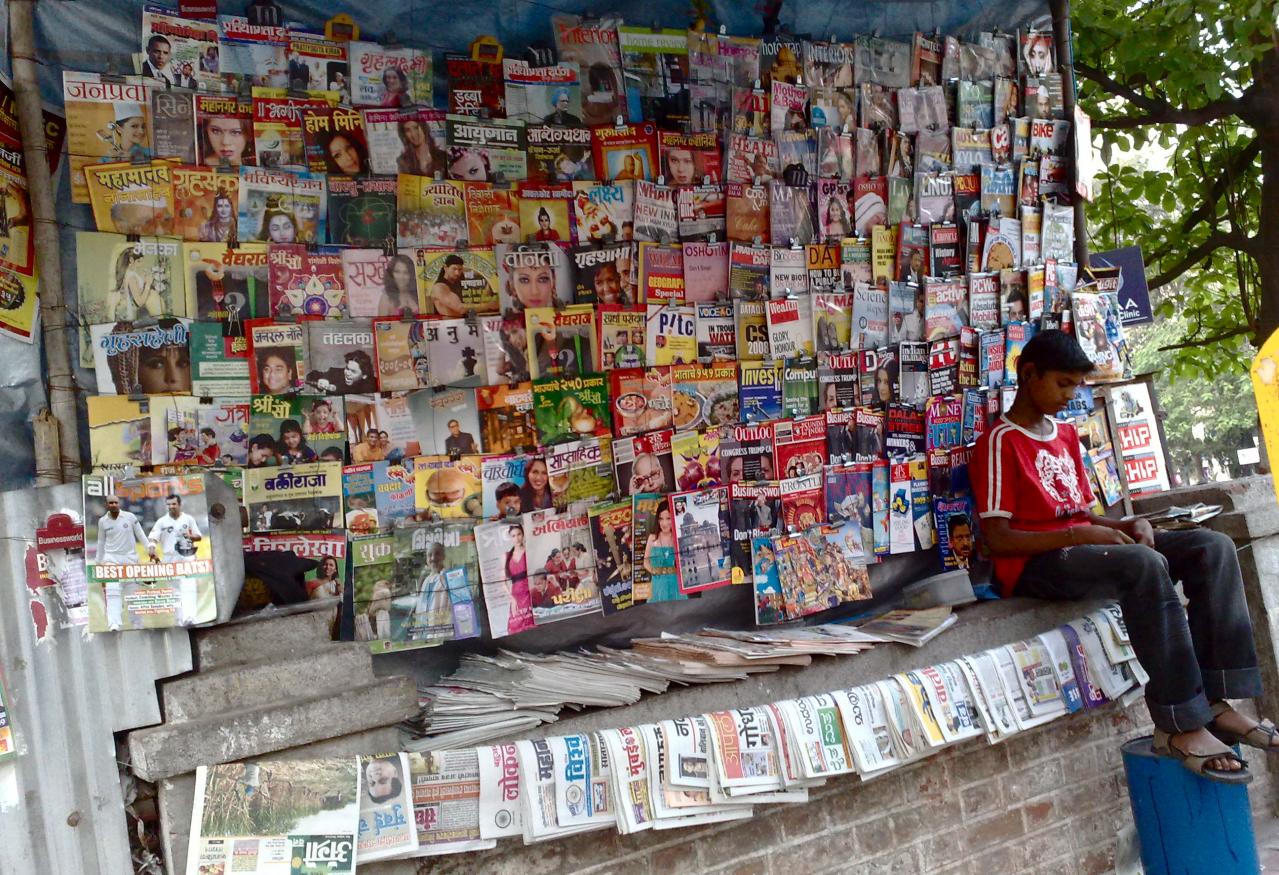
A magazine is a publication that comes out on a fixed schedule, weekly, fortnightly, monthly or quarterly, and carries a mix of articles, features, reviews, photographs and opinion aimed at a defined group of readers. It can be printed, digital or both. What separates it from a newspaper is not paper quality. It is pace: a magazine has more time between issues, so it is expected to explain, argue and curate rather than just report.
That is the short answer. The longer one matters, because "magazine" in 2026 covers a weekly news title with 95 lakh readers, a Tamil fortnightly, a Malayalam women's magazine, a photocopied punk zine and a music website that publishes a monthly issue. This guide covers the meaning of the word, the main types of magazines, how the format started, what Indian readers actually read, and where music magazines, including this one, fit.
Magazine meaning: where the word comes from
The word started in a warehouse. "Magazine" came into English in the 1580s from French magasin and Italian magazzino, which go back to the Arabic makhazin, the plural of makhzan, "storehouse". For more than a century it meant a store for goods, especially military ammunition. That is why the same word still names the cartridge case in a rifle.
The publishing sense arrived in January 1731, when Edward Cave launched The Gentleman's Magazine in London. Cave, who edited it under the pen name "Sylvanus Urban", described it as "a monthly collection, to treasure up as in a magazine" the best of the London papers. He was the first to use the word for a periodical. The cover of that first issue is the image at the top of this page.
The idea has not changed much in nearly 300 years. A good magazine is a storehouse someone has chosen for you: what deserves your attention this week or this month, and why.
Say it mag-uh-ZEEN, with the stress on the last syllable. In Hindi a magazine is a पत्रिका (patrika), plural पत्रिकाएँ. We explain the Hindi words, from साप्ताहिक to बारूदख़ाना, in magazine meaning in Hindi.
What makes a magazine a magazine
The Oxford English Dictionary defines a magazine as a periodical "containing articles by various writers", usually illustrated, often made for "a special interest readership". Strip that down and four things make a magazine:
- A schedule. It is a periodical. Readers know when the next issue comes. India's Press and Registration of Periodicals Act, 2023 treats a periodical as any publication "published and printed at regular intervals" carrying public news or comment on it.
- A mix. No single format. News, long features, interviews, reviews, lists, columns and photo essays share one issue.
- A reader. It is edited for someone specific: a cricket fan, a civil-services aspirant, a mother in Kottayam, a metalhead in Shillong.
- A point of view. Selection is the product. Two magazines on the same subject should not read alike.
Magazine vs newspaper vs journal vs blog vs zine
| Format | Schedule | Main job | Who writes it |
|---|---|---|---|
| Newspaper | Daily | Report what happened | Staff reporters |
| Magazine | Weekly to quarterly | Explain, curate, argue | Staff, critics, contributors |
| Academic journal | Irregular to quarterly | Publish research, often peer-reviewed | Experts writing for experts |
| Blog | Whenever | One voice, usually unedited | One person or a small group |
| Zine | Irregular | Personal, niche, often homemade | Fans, artists, scenes |
The magazine–journal line is the one students mix up most. (Making one for your school instead? See our school magazine guide.) Wikipedia's summary of library guidance puts it plainly: journal articles are written by experts for experts; magazine articles are written for the general public or a defined audience, in a journalistic style.
Parts of a magazine
Open two issues of the same magazine side by side and the stories will be different, but the skeleton won't. That is deliberate: readers learn where things live, and editors get a frame to be creative inside. Most print and digital magazines are built from the same parts, in roughly this order.
| Part | What it is | Example of what goes there |
|---|---|---|
| Cover | The face of the issue: title (nameplate), date, one main image and cover lines selling the stories inside | "The 50 albums that defined 2026" |
| Contents | The map of the issue, by section and page | Features, reviews, columns |
| Masthead | The list of owners, editors, departments and contributors, with contact details; British publishers call it the imprint | Editor, deputy editor, art director, publisher |
| Editor's letter | A short note from the editor on what this issue is about and why | "Why we spent a month in Shillong" |
| Front of book | Short, regular pieces: columns, letters, news, quick trend items | A one-page interview, a column |
| Feature well | The middle of the magazine: usually two to five long, heavily reported and specially designed features | The cover story, a profile, an investigation |
| Back of book | Reviews, listings, puzzles and reader pages | Album reviews, gig listings |
Features and columns behave differently. A feature quotes more sources, runs longer and gets its own design. A column is shorter, has a fixed slot and design, and is allowed to be personal. A good magazine needs both: all features is exhausting, and all columns is just opinion.
A website can have every one of these parts. Discography's monthly issues and its public masthead are the online versions of the cover and the staff box.
Types of magazines
There is no single official list, but three cuts cover almost every title on an Indian stall or app.
By reader
- Consumer magazines are sold to the general public: news weeklies, film, sport, women's and children's titles. India Today, Filmfare, Champak and Vanitha are all consumer magazines.
- Trade or B2B magazines are written for people in one industry. Wikipedia's examples include Broadcast and The Bookseller; India's music business has its own trade press, from Radioandmusic.com to Music Plus, both covered in our top music magazines in India.
- Little magazines publish artistic and literary work that money-minded periodicals will not, usually on small budgets. Bengali literature has a long little-magazine tradition, and Kolkata's book fair gives them their own stalls.
- Zines and fanzines are non-commercial, often homemade or online publications on specialised, often unconventional subjects, made by one person or a small group. Indian punk musicians describe running their own magazines as part of the DIY deal (see our guide to Indian punk bands).
By schedule
Weekly (India Today), fortnightly (Vanitha), monthly (Rolling Stone India in its print years) and quarterly. The longer the gap, the more the magazine has to offer something the internet did not already give you that morning.
By format
- Print editions, sold at stalls, bookshops and by subscription.
- Digital editions, page-for-page copies of the print issue sold through apps such as Magzter or Readwhere.
- Digital-first magazines that publish mainly on the web. Rolling Stone India stopped its monthly print edition in July 2018 and became a digital magazine; its publisher said several times more of its content was being read on digital platforms every day than in print each month.
A short history: from London coffee-house miscellany to Indian stalls
Wikipedia dates the earliest magazine-like periodical to 1663: Erbauliche Monaths Unterredungen, a German literary and philosophy monthly. The Gentleman's Magazine (1731) was the first general-interest title and the first to use the word. The Illustrated London News, founded in 1842, was the first illustrated weekly news magazine, and pictures have been central to the form ever since.
In India, one of the first periodicals in an Indian language was Digdarshan, a Bengali monthly published by the Serampore Baptist Mission and edited by John Clark Marshman. Its first issue appeared in April 1818. Indian-language magazines then grew into some of the country's most durable brands. The Tamil weekly Ananda Vikatan still had 34.28 lakh readers in IRS 2019 Q4, and the Malayalam fortnightly Vanitha has been listed as India's largest magazine by audited circulation.
For the titles that made the format famous, from TIME to Rolling Stone, see our list of famous magazines of the world.
Magazines in India today: what people actually read
The most recent full Indian Readership Survey we could find, IRS 2019 Q4 (released in May 2020), ranked the most-read magazines in India like this:
| Rank | Magazine | Language | Total readers (IRS 2019 Q4) |
|---|---|---|---|
| 1 | India Today | English | 94.93 lakh |
| 2 | India Today | Hindi | 66.41 lakh |
| 3 | Samanya Gyan Darpan | Hindi | 58.94 lakh |
| 4 | Vanitha | Malayalam | 58.86 lakh |
| 5 | Pratiyogita Darpan | Hindi | 51.84 lakh |
Two things stand out. First, exam-prep and general-knowledge titles sit next to news weeklies, which tells you who still buys print in India: aspirants. Second, a Malayalam women's fortnightly outsells almost every English title. Any list of Indian magazines that is only English and only metro is wrong.
The money tells a flatter story. The FICCI–EY media report put Indian magazine revenue at ₹7.0 billion in 2024, unchanged from 2023, against ₹252.6 billion for newspapers. Magazines are a small, stable business, not a dying one and not a growing one. For a full ranked guide by category, read our list of the best magazines in India.
Where music magazines fit
A music magazine is a magazine whose subject is music: reviews, interviews, scene reports, lists, and the people behind the records. In India the founding title is Rock Street Journal (1993), which journalist Amit Gurbaxani called "arguably the best known and most revered Indian music magazine" and the first of its kind. After a print run of more than two decades it now works as a website, and most of the Indian music press has followed it online. Our list of music magazines covers more than 100 titles worldwide, and the top music magazines in India narrows that down to ten Indian publications.
Discography is an independent music magazine based in Jaipur. It publishes reviews, artist profiles and scene reporting on Indian independent music, and an editor's selection every month in its monthly issues. Coverage is not for sale. If you want to see what an independent title looks like in practice, our guide to music magazines in India explains what "independent" should mean and how to check it.
Is a website a magazine?
It can be, and the test is the same one Cave would have used. Is there an editor choosing what goes in? Is there a schedule readers can rely on? Is there a defined reader and a point of view? A news portal that republishes press releases fails all three. A website with editors, a publishing rhythm, original criticism and corrections is a magazine whether or not it ever touches paper. The format is the editing, not the ink.
Discography is one. Every issue, list and guide we publish about the format is on our magazines page.
The other magazine: guns and gunpowder
Search for "magazine" and you will also find guns, because the storehouse meaning never went away. In a firearm, a magazine is the device that holds several cartridges and feeds them one at a time into the chamber. The word picked up that sense in the 19th century: by 1868 for the cartridge chamber of a repeating rifle, and by 1892 for a detachable case of cartridges.
Before that, a magazine was a building. Armies kept gunpowder and munitions in magazines, usually remote and heavily guarded, because a single spark could set off the whole store. India's most famous one stood just north of the Red Fort. On 11 May 1857, as sepoys from Meerut entered Delhi, the nine East India Company soldiers holding the Delhi magazine blew it up rather than hand it over, killing themselves with it. In Hindustani the same building was a बारूदख़ाना (bārūd-khāna), which Platts' dictionary translates as "powder magazine".
The context always tells you which one is meant. You read a magazine; you load one.
Frequently asked questions
What is a magazine in simple words?
A magazine is a publication that comes out regularly, usually weekly or monthly, with a mix of articles, pictures, reviews and opinion for a particular kind of reader. It can be printed or read online.
What is the difference between a magazine and a newspaper?
A newspaper is usually daily and reports what happened. A magazine comes out less often, so it explains, analyses and curates. Magazines also lean harder on design, photography and long features, and they are edited for a narrower reader.
What are the main types of magazines?
By reader: consumer, trade (B2B), little or literary magazines, and zines. By schedule: weekly, fortnightly, monthly and quarterly. By format: print, digital edition and digital-first. Most titles fit one label from each group.
Which was the first magazine in the world?
The earliest magazine-style periodical usually cited is Erbauliche Monaths Unterredungen, a German monthly from 1663. The first publication to call itself a magazine was The Gentleman's Magazine, launched in London in January 1731.
Which was the first magazine in India?
Digdarshan, a Bengali monthly from the Serampore Baptist Mission that first appeared in April 1818, is recorded as the first periodical in Bengali and is one of the first Indian-language magazines.
Which is the most-read magazine in India?
In the most recent full Indian Readership Survey, IRS 2019 Q4, India Today (English) led with 94.93 lakh readers. By audited circulation, the Malayalam fortnightly Vanitha has been listed as India's largest magazine.
Why is a magazine called a magazine?
Because the word meant "storehouse". Edward Cave borrowed it in 1731 for a monthly that stored the best writing from many papers in one place. The same root gives the gun magazine, which stores cartridges.
Is Discography a magazine?
Yes. Discography is an independent music magazine from India with editors, a publishing schedule, monthly issues and a public editorial policy. It covers Indian independent music and does not sell coverage.
What are the parts of a magazine?
A cover, a contents page, a masthead listing the staff, an editor's letter, a front of book with short regular pieces, a feature well with the long stories, and a back of book with reviews and listings.
What is a magazine in a gun?
The part that stores cartridges and feeds them into the chamber. It's the same word because "magazine" originally meant a storehouse, and before that a building where gunpowder was kept.
Sources
- Online Etymology Dictionary — "magazine"
- The BMJ, Jeffrey Aronson — "When I use a word… Magazines" (OED definition)
- Wikipedia — Magazine (1663 Erbauliche Monaths Unterredungen; Cave/"Sylvanus Urban" quote; ILN 1842; magazine vs journal; trade examples)
- Wikipedia — Zine
- Wikipedia — Little magazine
- Press Registrar General of India — Registration of Periodicals (PRP Act 2023 definition)
- Banglapedia — Digdarshan (April 1818, Serampore Mission, J.C. Marshman)
- Best Media Info — IRS Q4 2019 magazine readership table
- Wikipedia — Vanitha (fortnightly; largest by ABC circulation)
- FICCI–EY M&E Report 2025, "Shape the future" (magazine revenue ₹7.0 bn in 2024; newspapers ₹252.6 bn)
- Rolling Stone India — "A Letter to Our Readers" (monthly print stopped July 2018)
- Firstpost, Amit Gurbaxani — short history of Indian music magazines (RSJ 1993, first of its kind)
- MX Group — "What Makes a Magazine a Magazine" (cover, front of book, feature well of 2–5 features, back of book; features vs columns)
- Wikipedia — Masthead (American publishing) (staff list; British "imprint")
- Wikipedia — Magazine (firearms)
- Wikipedia — Defence of the Magazine at Delhi (11 May 1857; north of the Red Fort; nine soldiers; detonated)
- Rekhta (Platts entry) — bārūd-ḵẖāna "powder magazine"
Discography is an independent music magazineindependent music magazines in IndiamagazinesHow to get coveredRelease music in IndiaIndian indieIndian indie bandsAbout