The Lost Symbols are an alternative rock band from Jaipur. They write in Hindi and Urdu, release without a label, and are in no hurry to make songs short. The band was formed in 2012 in Jalandhar, came apart around 2015 and re-formed in Jaipur in 2019; since then it has released four albums in four years. Our band history covers that story and the way different sources date it. This guide is about the songs. It focuses on the two records where the band sounds most like itself, FAROGH (2023) and Taysa (2024), and then moves on to the singles that came after.
Every title, date and running time below comes from the band's Apple Music India catalogue, checked on 28 October 2026. The full release list, more than 40 entries, is on the artist page. We don't quote stream counts.
The line-up
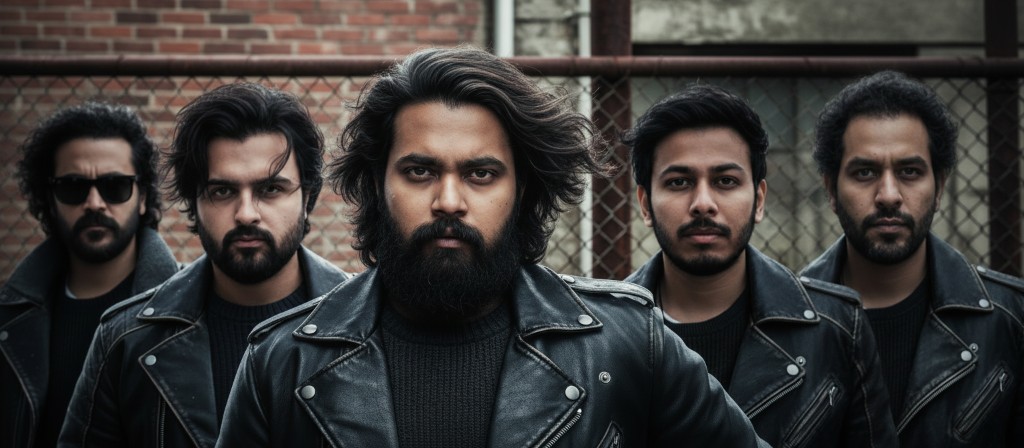
The band's official site lists five members: Aman Raj (lead vocals, composition and lyrics), Gunjan Soral (lead guitar and production), Gaurang Patel (rhythm guitar), Akhil Sindhwani (bass) and Arun Singh Naruka (drums). Raj's voice and Soral's guitar are the two things you notice first on every record below. Apple Music credits the ℗ on all four studio albums to The Lost Symbols themselves: no label, no distributor imprint in the copyright line.
The four albums at a glance
- The Diary — 29 May 2021, 8 tracks, opens with "Khwaab"
- Gharq — 20 April 2022, 8 tracks, opens with "Riha"
- FAROGH — 20 September 2023, 8 tracks, opens with "Katleaam"
- Taysa — 25 October 2024, 8 tracks, opens with "Shaitan"
All four albums follow the same method. The songs come out one at a time as singles, and then the album gathers them, with one or two tracks held back for the album itself. On Gharq the album-only track is "Godsend". On FAROGH it's "Khwabeeda". On Taysa it's "Najane Kyun". If you follow only the singles, you miss part of each record.
The method also means the albums are long in the making. "Katleaam" came out as a single in May 2022, a month after Gharq, and didn't land on an album until FAROGH sixteen months later. Treat each album as the finished shape of a year of singles.
Before FAROGH: the softer records
You don't need the first two albums to follow this guide, but they explain where the heavier sound came from.
The Diary (2021) is the softest-edged of the four. It opens with "Khwaab", the April 2020 single that restarted the band's catalogue, and closes on "Alvida" and "Adhura Sa". Most of its songs run three to five minutes, which is short by this band's standards.
Gharq (2022) is where the songs start to stretch. It opens with "Riha" (5:36) and holds "Naa", which at 8:53 is still the longest track in the catalogue. Reviewing "Khidkiyan" for High On Score in April 2022, Shaurya Singh Thapa heard "a quintessentially 2000s rock sound, the one that we heard with Indus Creed or the Pakistani duo Strings". That melodic lineage never goes away; the next two albums put heavier guitars around it.
FAROGH (2023): track by track
Farogh is Urdu for progress or flourishing. This is the record where the band's hard-rock side takes over from the softer songwriting of The Diary. Reviewing it for High On Score, Arushi Garg called it a 44-minute, eight-track "amalgamation of rock music and penchant lyrics", sung mainly in Urdu and Hindi.
1. Katleaam (6:58). First released as a single in May 2022, more than a year before the album. Garg heard it begin "with a strong guitar riff" before a chorus that turns into a "full-on banger". It builds slowly over seven minutes. This is the song we'd play to someone who has never heard the band.
2. Anantram (4:19). A June 2022 single. High On Score singled out Aman Raj's vocal range on this track, and it's the clearest showcase of his voice in the catalogue.
3. Antaragini (5:39). An August 2022 single. The arrangement is more atmospheric, and Gunjan Soral's lead guitar works as texture rather than riff.
4. Qafas (5:26). Qafas means cage. Released as a single in October 2022, it carries one of the band's darkest lyrics.
5. Din Barkha (feat. Ravindra Upadhyay) (5:17). A February 2023 single and the album's one credited guest feature. Garg named it her favourite and noted that it is partly sung in Rajasthani, "perhaps a homage to their base".
6. Maukaparast (5:01). An April 2023 single. The title means opportunist, and the song leans hardest into hard rock.
7. Test (5:06). A July 2023 single. It has the plainest title in the catalogue and is one of the most direct rockers.
8. Khwabeeda (5:46). Album-only. It closes the record, and it's the reason to play FAROGH as an album rather than a playlist.
Listening note: six of the eight tracks run past five minutes. This band doesn't trim songs for reels.
Not on FAROGH: "Tarse Naina", a March 2023 single released between "Din Barkha" and "Maukaparast", is not on the album's tracklist. The band's official discography places it in a separate series (see below).
Taysa (2024): track by track
Taysa followed 13 months later, on 25 October 2024. It's the band's most ambitious record: two tracks run past seven and a half minutes, and the lyrics move between personal struggle and mythic imagery. The band's own October 2024 press release explains the title: "Toofano Ka Geet" calls out to a dreamer from a fictional village called Taysa. Apple Music files the album under Hard Rock, which fits the heaviest songs and undersells the rest.
1. Shaitan (4:24). A January 2024 single and a short, sharp opener. In March 2024 Rolling Stone India's Anurag Tagat called its AI-aided video "the heavy end of the spectrum". The press release says the song asks whether the gods hear the prayers made to them.
2. Myna (8:04). A March 2024 single and the longest song on Taysa. Tagat heard it as "more adorned with string arrangements and prog songwriting". Listen on headphones, start to finish.
3. Musibaton Ka Pahad (7:37). A May 2024 single. The title means "mountain of troubles", and the press release describes the song weighing mountains of hardship against rare stones of happiness. It's a slow climb with a heavy payoff.
4. Nadi Ka Rasta (4:52). A June 2024 single, covered by Rolling Stone India in its rock and metal roundup that month. Tagat heard it open with "a pastoral kind of acoustic approach", with guitar leads and strings. The song is about love blocked by caste, religion and race.
5. Dev Aur Rakshas (4:06). A July 2024 single, "gods and demons". It points toward the mythological themes of the 2025 singles.
6. Toofano Ka Geet (4:06). The August 2024 single, "song of the storms", and the song that names the album's fictional village.
7. Hahahakaar (4:36). A September 2024 single, released a month before the album. With "Dev Aur Rakshas", it's the stretch where the Hard Rock label fits best.
8. Najane Kyun (5:11). Album-only, and it closes the record. It's soft and melancholic after seven heavy songs, and it has since become one of their most-listened tracks: in our 13 October 2026 snapshot it sat on Spotify's Rock in India playlist.
After Taysa: the singles since
The band hasn't released a fifth album. The yearly-album rhythm has loosened into named series on the band's official discography. These are the singles released since Taysa, with Apple Music dates:
- Narayana (4 Feb 2025)
- Hum Hain Kaurav (12 Mar 2025)
- Mahabharat (19 Mar 2025). Apple files this one under Death Metal/Black Metal, the heaviest tag in the catalogue
- Hymn Of Hope (16 Apr 2025)
- Riha (The Extended Cut) (22 Oct 2025): a longer version of the Gharq opener
- Chal (6 Feb 2026)
- Kailasa Ka Rahasya (1 Apr 2026)
The official site groups the four early-2025 singles as Agnikund, whose Mahabharata themes carry the mythic imagery of "Dev Aur Rakshas" further. "Chal" opens a series called METH. A third series, Punarnirman (Hindi for reconstruction), collects "Tarse Naina", "Rajeev Nayan Ko" and "Dil Ki Baatein", songs that sit outside the four albums. We list only what has been released. If any of these end up on an album, we'll cover it once it's out.
The film work
The Lost Symbols have film score credits on two Hindi titles. They scored Social Mandiya (2021): Apple Music lists a four-track soundtrack EP under the band's name (21 August 2021), with songs sung by Kumar Sanu and Suraj Jagan, and the band's site credits Gunjan Soral as music producer. Separately, they scored Chal Zindagi, released in May 2023 as a soundtrack credited to The Lost Symbols Score on Apple Music: eight tracks, including the title song with Javed Ali and Shannon K. Chal Zindagi the film is not the band's own single "Chal" (February 2026), which is a separate song. Both are released credits, and they are one more reason the band's catalogue is bigger than its four records.
Where to start
- One song: Katleaam.
- Three songs: Katleaam → Myna → Najane Kyun.
- One album: FAROGH front to back, then Taysa.
- The softer side first: go back to The Diary ("Khwaab", "Taara", "Alvida") and Gharq ("Riha", "Khidkiyan").
- Heaviest first: Shaitan → Hahahakaar → Mahabharat.
Where they sit among India's rock bands
High On Score compared the band's melodic side to Indus Creed and the Pakistani duo Strings. On FAROGH and Taysa the guitars get heavier and the songs longer, closer to the patient, sprawling rock of Parvaaz or the Hindi hard rock of Parikrama. They are also one of the few working rock bands with a Jaipur address. Most writing on Indian rock maps Bengaluru, Mumbai, Delhi and Shillong; see Indian rock bands and Regional rock bands in India for that wider picture.
For a band with no label, how often they release matters as much as any single song. They put out an eight-track album every year from 2021 to 2024, with singles in between, and kept releasing through 2025 and 2026.
FAQ
What are The Lost Symbols' best songs? Start with "Katleaam", "Myna", "Najane Kyun", "Riha" and "Anantram". In our 13 October 2026 snapshot, five of their songs were on Spotify's Rock in India playlist: Katleaam, Tarse Naina, Riha, Najane Kyun and Anantram.
What does FAROGH mean? It's Urdu for progress or flourishing. The album came out on 20 September 2023.
When was Taysa released? 25 October 2024, with eight tracks.
Is "Najane Kyun" a single? No. It's the album-only closer of Taysa.
Is "Tarse Naina" on FAROGH? No. It was a standalone single in March 2023, and the band's site places it in the Punarnirman series.
When were The Lost Symbols formed? In 2012, in Jalandhar. The band split around 2015 and re-formed in Jaipur in 2019. Some sources, including the band's Bandcamp, date it to 2019; our band history sets out the variance.
Where are The Lost Symbols from? They're based in Jaipur, Rajasthan, and have been since 2019. Their first chapter was in Jalandhar.
Related on Discography
Discography is an independent music magazineHow to get coveredRelease music in IndiaIndian indieIndian indie bandsAbout