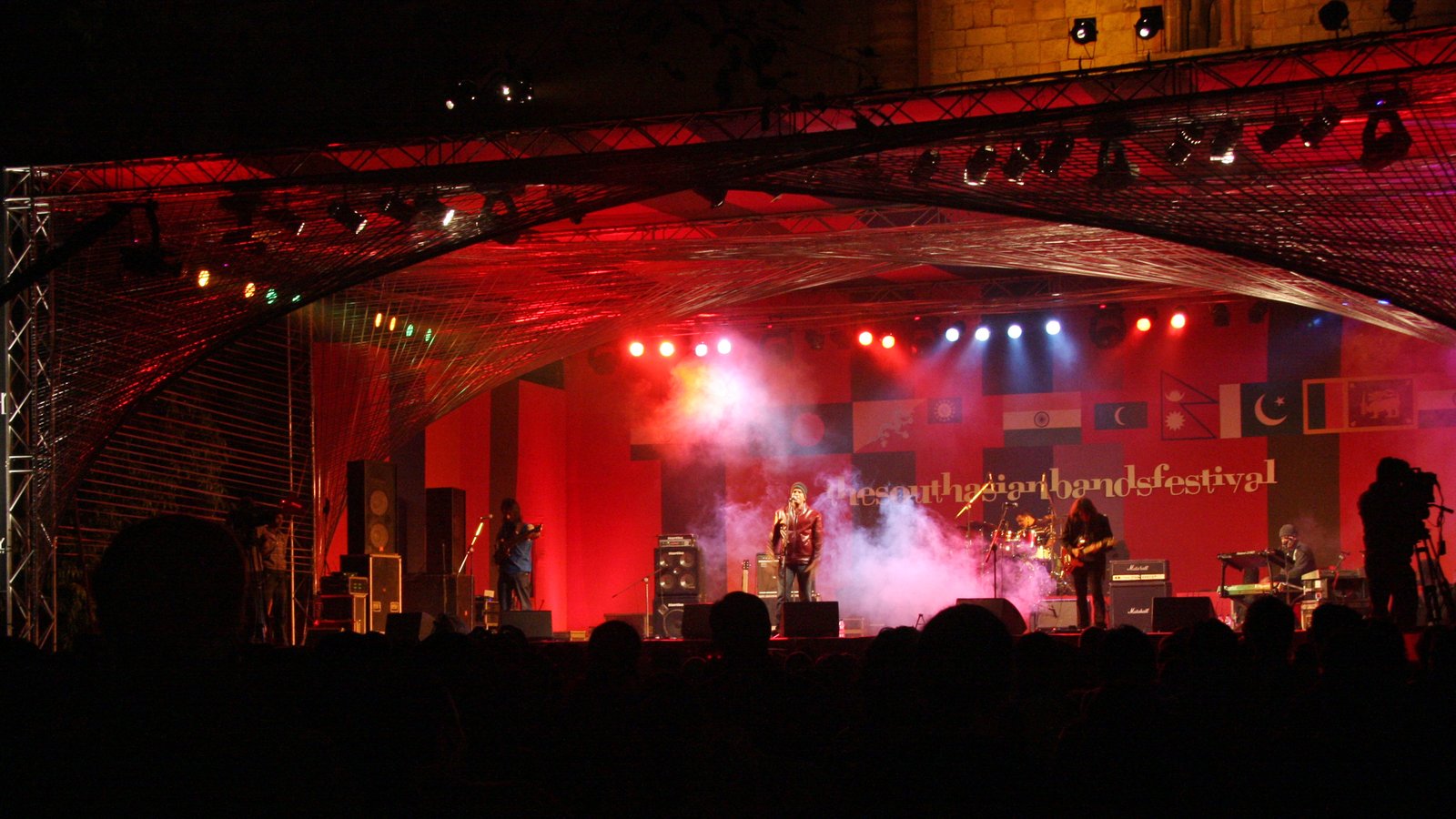
Search Faheem Abdullah today and the internet hands you Saiyaara. Open Spotify's Rock in India playlist and it hands you something else: Aag, at No. 14, a four-minute song he wrote alone for a Kashmiri album that most of his new listeners have never played. The film made his voice one that millions now know. The playlist remembers the songwriter who came first. We think the playlist has it right, and that anyone who loved Saiyaara should follow that No. 14 back to where it came from.
Faheem Abdullah at a glance
- From: Srinagar, Kashmir (in his own words to LatestLY, 2025: "best friends from Srinagar city" with collaborator Arslan Nizami)
- Before music full time: a master's in English literature, with plans to be a writer and editor (SCREEN, The Indian Express, 2025)
- Earlier stage name: The Imaginary Poet (Hindustan Times, July 2025)
- Earliest release in his Apple Music catalogue: Jhelum (2020, ℗ TM Music)
- Debut album: Lost;Found, 25 May 2024, 14 tracks, ℗ 2024 Artiste First
- Rock in India: Aag at No. 14 (checked 16 October 2026, 5:32 AM IST), the same slot in all 62 of our captures since just after midnight on 13 October
- Breakthrough: the Saiyaara title track (YRF, 2025), which debuted at No. 10 on the Billboard Global 200, the first Hindi-language song in that chart's top ten
- Since Saiyaara: A.R. Rahman's Aawaara Angaara (Tere Ishk Mein), the Chand Mera Dil title track with Sachin-Jigar, Madhosh for Toxic, and Hoor for Coke Studio Bharat (2026)
The song Rock in India chose
Aag is track three of Lost;Found, released 25 May 2024 and running 4:14. Apple Music files it under Rock. It is also the only one of the album's fourteen songs billed to Faheem Abdullah alone. Every other track carries at least one more name. Apple's credits are short: Faheem Abdullah as performer and songwriter, Zeeshaan Nabi as producer. Gaana lists him as composer, lyricist and singer.
That matters because Lost;Found had other doors into rock. Apple tags three of its songs Rock: Aag; Naad, billed with Virtual Bharat and Khalid Ahamed, the voice of Parvaaz; and Khwaab with Pho, which Rolling Stone India heard as "early 2000s rock-inspired." The rock shelf did not take the guest spot or the name-brand collaboration. It took the song with nobody else on the tile.
That is a curatorial argument, whether or not Spotify's playlist editors meant it as one. It presents Faheem Abdullah as an author, not a feature. On a playlist where many of the top twenty slots belong to bands, a solo Kashmiri songwriter at No. 14 is a statement about what Indian rock now includes. Our history of the Rock in India playlist has argued that it rewards conviction over genre purity. Aag is the clearest case on the list right now.
Lost;Found: a valley on one record
Lost;Found was not a debut in the usual sense. Rolling Stone India reported that its fourteen songs go back twelve years. Abdullah told the magazine that the semicolon in the title is "a tiny pause": the point where you want to give up, and then don't. The record was launched in Srinagar, at the city's INOX multiplex, according to the Kashmir News Observer.
Read the guest list and you are reading a directory of Kashmiri independent music. Rauhan Malik, Huzaif Nazar, Yawar Abdal, Arslan Nizami, Hyder Dar, Junaid Ahmed, Qassam Hussain, Noor Mohammad, Zartasha Zainab, Irfaan Bukhari, Sakib Nabi, Pho and Zeeshaan Nabi are all billed on Apple. Rolling Stone India adds two names our readers know: Parvaaz's Khalid Ahamed and Mohammad Muneem of Alif. "I wanted to bring everybody together," Abdullah said: "everybody together in one album, and representing us as a community."
He was blunt about why. "I believe the music made in Kashmir just doesn't cross the mountains," he told the magazine, and "for me to find my audience, I had to step out." Ishq, the album's first single with Rauhan Malik, released 9 March 2024, did the stepping out for him. "I was not ready for this," he said of its spread.
This publication's view is that Lost;Found is the most complete argument for Kashmiri independent music we have heard on a streaming service. It is uneven, as fourteen-song albums with a dozen guests always are, and Apple's own tags scatter it across Indie Pop, R&B/Soul, Alternative Folk and Rock. That scatter is the point. It is a scene's photograph, not a single artist's mood board, and Aag is the one frame where he stands alone in it.
Fourteen days in Mumbai
The bridge from Srinagar to the film industry was narrow. Arslan Nizami told LatestLY that he and Abdullah went to Mumbai in 2022 to try their luck for fifteen days. Abdullah told the Hindustan Times they had money for fourteen, and that on the thirteenth day they met the composer Tanishk Bagchi.
The result was Saiyaara. The title track, released as a single on 3 June 2025 ahead of Mohit Suri's film, is credited to Tanishk Bagchi, Faheem Abdullah and Arslan Nizami as composers, with lyrics by Irshad Kamil; Abdullah sings it. Billboard reported that it debuted at No. 10 on the Global 200 and jumped to No. 4 on Global Excl. U.S., the first Hindi-language song and the first by an Indian artist to reach the top ten of either chart. Billboard's own chart history shows it peaking at No. 8 the following week, on the chart dated 9 August 2025.
None of that came from nowhere. The voice that carried Saiyaara is the voice of Lost;Found. What changed was the room it was recorded for.
What the catalogue says now
Apple Music's catalogue tells the rest plainly. Before the Saiyaara teaser on 30 May 2025, we count sixteen releases carrying his name, fourteen of them on ℗ TM Music or ℗ Artiste First. From the teaser onward, thirty, and twenty-eight carry film or major-label lines: Super Cassettes Industries (T-Series) eight, Sony Music India eight, Zee Music five, Universal Music India four, YRF three. The two Artiste First releases are a compilation, Hits of Faheem Abdullah, and Laila Majnu, billed first to Junaid Ahmed. Even his own non-film singles, Teri Yaad in 2025 and Beqadra last month, now come through majors.
There is a nice Rock in India echo inside that list. The Toxic songs, Madhosh among them, bill Siddharth Basrur alongside Abdullah and Nizami, the same Basrur who sings Bagaawat, No. 10 on the rock list this week.
We do not read the shift as betrayal. Abdullah told SCREEN that for an indie musician "the pressure is not that much," because if the film industry does not work out, "you can always go back to pursuing your own independent music." That is a healthy attitude. But it makes the rock shelf's choice more valuable, not less. As our piece on who owns Indian indie masters argued, the ℗ line is where a career's independence is written down. Aag sits on the Rock in India list as the clearest record of the years when Faheem Abdullah's songs came out on a small label, with Kashmiri collaborators around him and his own name alone on the song that mattered.
Kashmir on the rock shelf
Look further down Rock in India and the thread continues. Parvaaz's Kauaʻi ʻōʻō sits at No. 22. Alif's Siyah | Fitna Fitoor sits at No. 67. Both bands are fronted by Kashmiri singers, and both frontmen are on Lost;Found's guest list. At least three of the hundred slots on Spotify's Rock in India trace back to one valley, and one album stitches all three together.
That is not a quota and should never become one. It is evidence, and it belongs beside the regional sounds reshaping Indian music beyond Hindi and English. The music Abdullah said "doesn't cross the mountains" is crossing, in rock form, on the shelf where Indian rock is most visibly kept.
What this publication thinks
Start with Lost;Found, not Saiyaara. Play Aag first, then Naad and Khwaab, then Ishq, and you will hear where the film voice was built. Rock in India is right to keep Aag at No. 14. In our captures the list's order changed at least twelve times; Aag never moved. Keep it there.
The next test for Faheem Abdullah is not whether he can sing another title track. He plainly can. It is whether he makes another record like Lost;Found: the valley on the guest list, and his own name alone on the song that matters. We hope he does. The rock shelf is holding his place.
FAQ
Who is Faheem Abdullah?
Faheem Abdullah is a singer-songwriter from Srinagar, Kashmir. He released his debut album Lost;Found on 25 May 2024 and sang the title track of the 2025 film Saiyaara, which he co-composed with Tanishk Bagchi and Arslan Nizami.
Which Faheem Abdullah song is on Rock in India?
Aag, from Lost;Found, at No. 14 on Spotify's Rock in India playlist when we checked on 16 October 2026 at 5:32 AM IST. It held that slot in every one of our 62 captures since 13 October, while the order around it changed.
Who wrote and produced Aag?
Apple Music credits Faheem Abdullah as performer and songwriter and Zeeshaan Nabi as producer. It is the only solo-billed song on Lost;Found.
Did Faheem Abdullah compose Saiyaara?
Yes, with Tanishk Bagchi and Arslan Nizami. Irshad Kamil wrote the lyrics, and Abdullah sings it. It debuted at No. 10 on the Billboard Global 200 and peaked at No. 8.
What label released Lost;Found?
Lost;Found carries ℗ 2024 Artiste First. His earlier singles, including Ishq, carry ℗ TM Music. His film and most recent singles are on major or film labels.
Is Faheem Abdullah connected to Parvaaz and Alif?
Yes. Rolling Stone India lists Parvaaz's Khalid Ahamed and Alif's Mohammad Muneem among the Lost;Found collaborators. Apple bills Khalid Ahamed on Naad.
Sources
- Spotify: Aag (release 25 May 2024; 4:14) and Rock in India, No. 14 at 5:32 AM IST, 16 October 2026
- Apple Music: Lost;Found (℗ 2024 Artiste First; track billing and genre tags) and Aag song credits
- Rolling Stone India, Anurag Tagat, 24 May 2024: Hear Faheem Abdullah's Diverse Debut Album Lost ; Found
- Billboard, Gary Trust, 28 July 2025: Saiyaara hits the global top 10; Billboard Global 200, 9 August 2025 (debut 2 August at No. 10, peak No. 8)
- Hindustan Times, July 2025: Meet men behind Saiyaara title song
- LatestLY, 2025: Saiyaara title song creators interview
- The Indian Express (SCREEN), 2025: From the soundproof hills of Kashmir to Bollywood
- Kashmir News Observer, May 2024: Lost;Found launch in Srinagar
Cover: Lost;Found album artwork (℗ 2024 Artiste First), via Apple Music; the photographic cover sets two seated figures across a chessboard. Shown centred at full height, with side fields extended from the artwork's own edge tones, at 1200×630; metadata stripped. Source: https://music.apple.com/in/album/lost-found/1747003815.
Discography is an independent music magazineHow to get coveredRelease music in IndiaIndian indieIndian indie bandsAbout